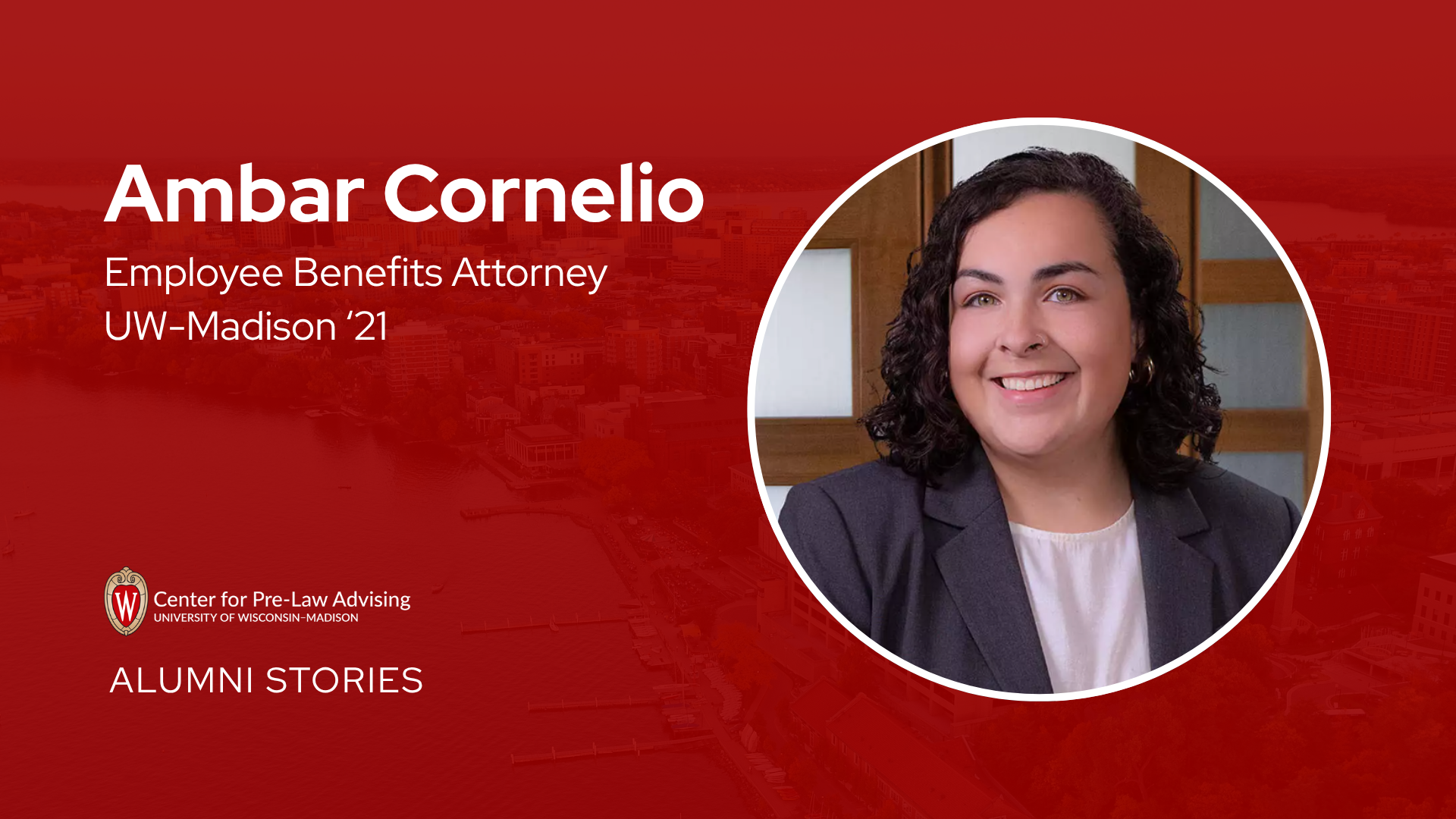
Ambar Cornelio (Class of 2021), Employee Benefits Attorney
The Center for Pre-Law Advising interviewed UW-Madison alum Ambar Cornelio (Class of 2021), an Employee Benefits Attorney in Milwaukee, WI. Ambar is a double alumna of UW-Madison, having earned both her undergraduate and law degrees here, and is now in her second year of practice at a mid-size law firm specializing in retirement plans and related compliance issues for trade-sector union clients. Her work also blends aspects of family law and trusts and estate law in a retirement plan-centered context.
See our conversation with Ambar below, where she shares insights into her journey to law school and beyond, lessons learned, and advice for aspiring professionals.
Fall 2025 Interview with Ambar Cornelio
Q: How did you discover this career path? What led you to choose this path?
A: In law school, I earned a Concentration in Employment Law (similar to an undergraduate certificate at UW). I learned a lot about the types of clients I personally work for (trade-sector unions) and tangential issues (unionizing with the hopes of improving the workplace, which often includes providing workers with benefits such as retirement and/or health plans). These helped serve as a backdrop to my career interests, but I learned so much more once I actually started practicing at my firm.
Q: How did your time at UW-Madison help prepare you for where you are now?
A: At UW, I majored in Art History and Spanish, which are very humanities-based courses. I did a lot of reading of articles, research and writing which helped form a foundation for my time in law school, and eventually my job now. Although my experience with undergraduate reading and writing was significantly different from legal research and writing, the hard skills of research, writing and the interest to try to figure out the pieces of a puzzle have been invaluable to my career. Beyond the classroom, different (and not legally related!) job experiences in undergrad were invaluable. In essence, lots of practicing law and communicating with clients is customer service: someone comes to you for a particular purpose and you’re there to help. In undergrad, I used to tutor for Spanish courses and worked at the Badger Market in Memorial Union – people came into the store or for tutoring for a particular purpose, asked me to help, and assist in getting what they need. In may ways, practicing law boils down to similar principles.
Q: How often do you work with others vs. independently in your current role?
A: I individually complete my work, but I work with others because I draft correspondence for a more senior associate and/or shareholder review. I frequently pop into someone else’s office or pick up the phone to strategize responses. My department is holistically collaborative, which means that even very senior shareholders will frequently ask more junior shareholders or associates for insight on how to tackle a particular issue or respond a certain way.
Q: How do you maintain work-life balance?
A: I set strong boundaries and maintain consistency as much as possible in my work week. This means that I arrive to work and leave at similar times so I have a more accurate gauge of how many hours I expect to bill daily. Even if I am at the office 8+ hours a day, this does not mean that I am able to bill clients for the entire time I am in office, but rather only for work I complete for clients. By having consistency, I am able to get done what I need to do and am able to work less on weekends, which allows me to rest and do things outside of my job that are important to me. For boundaries, I try not to check my email past a certain time and, if I’ve hit my goal in how many hours I wanted to bill that day, I feel content and allow myself to be done rather than incessantly push and find other things to do. This allows me to be more rested and not fall into burn out.
Q: What kinds of opportunities (research, internships, clinics, etc.) have you found most valuable in your journey?
A: In law school, I was a research assistant for a constitutional law professor, and an extern in the legal department for a venture capital firm. When working in those spaces I spent lots of time looking for and at scholarly articles and statutes, and diving into unique areas of law. These skills of legal research were incredibly helpful when I started my job, where lots of what I do are diving into, figuring out and applying the law. In law school, I also advised at CPLA and worked as a Legal Fellow, which allowed me to meet so many people in their various stages of preparation for law school. The legal profession is a people-based profession: getting to know people, helping them with a task, assess risk and strategize responses like I did in the application context are hard skills that are still pertinent to my job.
Q: What advice would you give your younger self?
A: Although applying for and doing law school is difficult, you can do it and you deserve to be part of the profession. Separately, the experiences you have (even when they aren’t legally related) are not “too insignificant” or “unrelated” to law school – you can learn so much in customer service jobs.
Q: What words of encouragement would you share with students who may be unsure or intimidated by this career path?
A: Truly, I’ve been there. Even if you don’t have resources like a family member that is in the legal profession (I genuinely didn’t know anyone when applying to law school and had never even step foot in a law firm/talked to an attorney), use the resources you DO have (like going to CPLA!). Your questions aren’t too stupid, too dumb or too easy – you deserve to take up space. It’s much better to ask questions and feel relieved/have tangible action steps rather than stress out, not reach out and potentially not present the best version of yourself with the application process.
Q: What’s one small habit or mindset shift that made a big difference in your journey?
A: It’s been helpful for me to be reminded that even those that “seem” to have it all together, or always have the right answers, they both 1) often still don’t have all the right answers, and/or 2) didn’t always have it together and I am seeing them after years and years of hard work. It is easy to compare yourself to where you are now and where someone else is now, but don’t forget that the version of someone you see now is the product of lots of hard work, making mistakes and asking questions – just like you (I) may be doing now. It’s part of the job and how you learn.